Monday, October 29, 2007

Holidays can be fun or disastrous

It may seem like childish advice and stating the obvious. Said advice being not losing your essential documents and most especially when you are travelling abroad.

Anyway it must be one of the most distressing things you can ever feel when arriving at a foreign airport for an international flight and realising that you have lost your tickets. Well, make that the second most distressing thing since the most distressing would be to have lost your passports. To have lost both while travelling abroad would be absolutely disastrous.

Losing your travel documents can be downright troublesome even when one is not travelling abroad. Getting a replacement can be quite a hellish experience because whether or not you do get a new passport depended very much on the Immigration Department.

“Atas budi bicara Ketua Pengarah Jabatan Imigresen Malaysia.” Well, the poor Director-General always gets to shoulder the blame whether or not he is personally involved in the decision to give you a replacement passport or not. My guess is that somebody else decides beforehand whether you deserve a new travel document and if you do whether it has some form of restriction or other attached to it before the documents reached the DG’s desk for his signature.

Which is why it would help a whole lot if you look honest. I mean, try and paint a picture to the immigration officer handling your case that you do not have the kind of face which belongs to a person who is likely to sell his or her passport on the black market and then go apply for a new one, thereby doing a roaring business. This is in fact one of the reasons getting a replacement passport after you have lost one is hell. In case you did not know, Malaysian and Singaporean passports are said to be the most valuable and expensive travel documents in the world on the black market. I say this not through personal experience. What I am quoting is just hearsay as I have never actually lost my passport. Touch wood. But I was told the reason our passports are so expensive has something to do with our diverse ethnicity. As to why this is so, please go figure. Suffice to say that the Malaysian authorities do not take very kindly to your losing travel documents, whether intentionally or unintentionally.

But back to our lost ticket story. Thank goodness that these days most airlines have gone electronic. For those still not in the know, you can actually travel paperless these days. Just do your bookings and jot down your booking reference code. Even if you have forgotten your reference code, just handing in your passport at the check-in counter will suffice as the staff attending to you would be able to confirm your flight and issue you your boarding pass. Just try to remember your flying date, time and flight number. Easy as that.

This, however, works only if you are travelling on one sector. Should it involve different sectors, say flying to Bangkok then on to Tokyo then you still could not go paperless just yet. Which is when problems like losing your tickets sometimes arise. Imagine the sinking feeling in the pit of your stomach on arriving at the airport and discovering that you have no tickets to travel with.

Some months ago I arrived at Suwarnabhumi International Airport, Bangkok’s spanking new terminal, and managed to catch the tail end of a verbal exchange between a couple. Well, it was actually one-sided. A couple had alighted from a taxi just a minute or so before I did when they realised that their air tickets were still in the taxi. And the taxi had already left the airport area.

The man, about a hundred kilos of him and who must be in his late 40s or early 50s, sounded very Italian. The wife, a petite young thing who could not be more than 25, and carrying a baby who must be a few months old to boot, just stood pale-faced and defenceless against the verbal onslaughts of her husband. Although I have not met that many Italians in my life, I have met a few, which I must say is more than enough for me to form an opinion that Italian men by nature are very passionate and excitable people. A normal conversation can often sound like an argument. So you can imagine what can come out of his mouth when he is in such a state.

In that instance, his English may be peppered with Italian, but he certainly was making his feelings understood not just by his wife but everybody who was in the vicinity of the drop-off area at the airport. Indeed, the adjectives he used, and there were quite a few mind you, to describe his wife’s state of mind at that moment and thereby her overall intellect, were some of the most colourful I have heard. If anybody had had their doubts before that, after his tirade it was clear he never married her for her brains. Nuclear physicist, she was certainly not. In the bedroom and in the heat of passion you may be excused for using some of the words but certainly it was in very poor taste when uttered for complete strangers to hear in a very public place.

Much as I would like to step in and help, I have lived a long and relatively peaceful life. And one of the things I have learned if you want to continue living a long and relatively peaceful life is not step in between an irate Italian and his Thai wife. In fact one should never step in between any man and his wife when they are in the middle of a heated exchange, even if they are your closest friends. Worst still if they are not. You may just end up with a black eye for your effort instead of words of gratitude from either party. While the Italian and his wife were still at it, I decided to let them figure out for themselves what they were supposed to do and went to check in for my flight back to Kuala Lumpur.

In fact if he had not been in such a state, he would have realised that should you ever lose your tickets all you need to do is go pay for new tickets and upon returning home file a claim for lost tickets with your insurance agent. Which is why it is essential that when you travel you first buy travel insurance. If you did not then there is nothing that can be done except bear the losses and be more careful with your travel documents and flight tickets the next time you go for a trip.

It is the difference between a completely beautiful holiday and a disastrous one.

Friday, September 21, 2007

Sick away from home

In April I had a chosen an unusually wet morning to call a taxi and head for the Kuala Lumpur International Airport. For a while I was wondering if I would make it in time for my flight. The rain was pouring relentlessly along the KL-Seremban Highway and you can only just make out the rear ends of the vehicles in front. Credit to the taxi driver though, a veteran of more than 20 years on roads and routes in the Klang Valley, who drove at a reasonable speed considering the circumstances and got me to the airport ahead of time.

My clothes were slightly damp and it was cold all the way during the flight from KL to Bangkok. But out of the cool confines of Suwarnabhumi International Airport, Thailand’s latest state-of-the-art airport, reputed to be the most modern in Asia, it had to be the hottest day recorded in Bangkok so far this year at 40 degrees Celsius. April may be known as the hottest month in Thailand and it was after the Songkran or water festival and all that. But even by Bangkok standards it was stinging hot and I mean that in the most literal way. My skin was feeling a bit prickly during the taxi ride to the hotel. Such extreme change in the weather and temperatures, coupled with a lack of sleep on the previous night ensured that by evening I was down with a fever and I had to spend most of the day in my hotel room sleeping.

The room overlooked the swimming pool and from four floors up I was entertained by a bevy of several nationalities showing off their prowess in a variety of swimming styles. Of particular interest were two girls who were demonstrating more than just the usual camaraderie among travelling companions. This was a bit more than your usual female bonding to trade gossips about the latest fashion. Even to the casual observer, and I consider myself to be that, they were showing just a little too much interest in each other’s anatomy for my comfort. Their swimming style was of course the breast stroke and one of them was a good swimmer at that while the other rode piggy back.

Tsk! Tsk! Forgive me for being a prude. But I come from the state of Kelantan, where men and women do not share the same trishaws or pay for goods in the supermarket at the same check out counters. Come to think of it the two ladies would have had no problems at all if they were in Kelantan. They would have had fit in nicely so long as they shed their bikinis for shorts and t-shirts before entering the hotel swimming pool. After all in Kelantan these days same sex dancing is now not just the in thing but is widely encouraged. I am not all that familiar with the subject of psychology, but I can bet Freud would have said this is encouraging a split personality among the girls. Anyway I suppose what the two ladies were doing was as close as it can ever get to synchronised swimming in a hotel pool.

If these were not problems enough I had to be up early the next morning to catch another flight, this time to Hanoi. By that time my fever was threatening to get out of control. But nothing some self medication could not take care of, so I just stepped into the first pharmacy I saw at the airport. It was another two hours flight or so from Bangkok to Vietnam’s capital city. If Bangkok was scorching hot then Hanoi was about 18 degrees Celsius, which again was cold by my standards and absolutely dreadful when you are down with a fever.

Even the pretty nice looking immigration officer waiting to assist people at the airport failed to interest me. I was told things had improved tremendously of late and you no longer have to stand for hours waiting for your passport to be stamped. Vietnam after all had come of age and is marching furiously into the future embracing all kinds of technology – from the latest mobile phones from China to the most up-to-date computers. Technology can only do so much of course. The way their civil servants do things say a lot about their attitude. For example I am still trying to make sense of the fact that after my boarding card had been issued at the airport why would an immigration officer want to see my return ticket. Or the fact that you had to fill up the arrival and departure cards. The arrival card was taken when you arrive but the departure was just for me to take as a souvenir back to Kuala Lumpur.

Immigration aside, one thing you do not ever want to do is fall sick while on a trip to a place you have never been to before. Kind of put a damper on your sight seeing plans. After lunch and a shot of antibiotics and cough syrup I just decided to sleep it off and declined the offer to go for a tour of the city. Thereby I lost my chance to visit a local market and see skinned dog meat on display. The shock could have either cured me instantly or make me sicker.

The sleep refreshed me somewhat and I woke up at about 2am feeling a whole lot better. I may have opted out of the tour earlier in the day but had no intention of missing dinner. But miss it I already did. I looked out the window of the hotel room and the streets were practically empty. The city also seemed to have grown darker as houses and buildings have switched off their lights. Shops had closed for the night and there was nothing much I can do about the gnawing hunger. I had a dislike for room service because it reminded me of hospital rooms. How I suddenly miss having a 24-hour mamak stall around the corner and popping over for some coffee and roti canai.

Luckily there was an electric kettle in the hotel room to boil water and make coffee. Complimentary from the hotel. In the fridge were also some chocolates. Chargeable of course. There was this small bar of chocolate which is quite popular in Malaysian shops which you can pick up for about RM1.50 or so. Much as I also dislike consuming food from hotel mini-bars I was left with very little choice. I had a little snack hoping to avoid dying of starvation before the breakfast buffet opens in the morning. Three days later when I was checking out of the hotel I was slapped with a bill of some US$5 for the bar of chocolate. That was the most expensive packet of Kit Kat I ever paid for and is likely ever to pay for.

Wednesday, August 29, 2007

Hot dog, anyone?

Vietnamese women are built very much like their houses. Tall and slim with just a touch of French flavour. Well, this is the case in Hanoi (or Hanot as the locals pronounce the capital city) at least.

The buildings are built that way because land in Hanoi is scarce and the population is over four million. So there is a need to have as small a base as possible with the houses rising up a minimum of three storeys. The land mostly belongs to the government which gives them out to individuals to build their houses. I must add here that land in Vietnam is non-hereditary except if it is ancestral land. The women got that way presumably because of the bicycling they used to do. Not anymore, though, because everybody seemed to be moving around on motorbikes which have become the new preferred form of transport. The more affluent in fact whiz around in Japanese-made cars. Therefore the women must have remained slim because of the several flights of stairs they have to climb daily in their homes.

Another reason could be because the Vietnamese, I was told, were not great eaters. They just eat the three main meals and do not snack in between. And they love to exercise and keep fit. Looking out of my hotel room window eight floors up I could spot a man in white shorts and t-shirt exercising furiously in front our hotel in the wee hours of the morning. But upon closer inspection, I realised that it was not a Vietnamese man I was looking at. It was one of my bosses from Bangkok. He is a health freak whose daily regiment includes a run a few times round the block in whatever city he may be followed by lots of raw vegetables and fruits for breakfast, lunch and dinner. He is one step ahead of the Vietnamese, I must say, in the art of keeping healthy.

Anyway I keep digressing. A friend actually pointed out that Vietnamese women looked slimmer than their Asian counterparts because of optical illusion which he attributed to the dress most of them wear. Called au yai, it consists of a mid-calf (or what in the 1970s we used to call midis as opposed to minis) or maxis (ankle-length) cheongsam with slits on both sides running up to the waist. These are made from either silk or cotton. Of course they still wore long pants under the skirts. Otherwise it would have become totally x-rated instead of being a most elegant and beautiful national costume. The au yai without the pants would have caused terrible accidents on the roads all over Vietnam and reduced the number of males further. As it is out of the 80 million people or so, more than 50 per cent are women.

Coupled with that, the motorbikes also travel at speeds that make you stand rooted for a long time by the side of the road before crossing. The first time I tried crossing a road I must have stood there for five minutes before mustering up enough courage to make an attempt. I was waiting for the number of bikes to lessen. No such luck, so as calmly as possible I walk across with a few motorbikes coming at me at breakneck speed. Wonder of all wonders without even slowing down one bit they somehow managed to avoid running me over. If you think that is bad enough, try doing it on a road where the traffic comes at you from both sides with a couple of horns blaring at the same time. The pace used to be much slower when bicycles ruled the roads, I was told. Now the bikes have taken over and all other vehicles, from cars to lorries must give way to them. I can understand that in the days of bicycles this must have been an act of deference to the proletariat class or something like that. But now I think the drivers of other vehicles are just afraid the Hanoi Mat Rempet will team up and beat them senseless in the event one of their brethren is run over. It did not matter whether it was night or day. The number of motorbikes did not seem to decrease very much, at least up until midnight or so.

Which actually mean you need nerves of steel and should not let your mind wonder too much when crossing roads. Worse of all do not let your eyes wander at all to the girls clad in au yai standing across the road. I must say that in the four days I was there, several times I was moved considerably to consider ending my bachelorhood if not for one tiny fact. I was rather afraid for my neighbour’s dogs. Call me picky but I would still rather have beef in my hotdog. To be fair Vietnamese do not eat dog meat all the time. Only during the second half of the month. They consider eating dog meat during the first 15 days to be bad luck. I would say the first half of the month is good luck for the dogs, which are reared specially for food. In one part of Hanoi, I was told, there are 60 restaurants all selling dog meat cuisine. I took their word for it and turned down the offer to go for an inspection.

In fact if I had wanted to have a look I need not have gone that far. Some of my colleagues went for a walk at the wet market beside the hotel we were staying and saw freshly slaughtered and skinned dogs on display. So they whipped out their cameras and started clicking away. This had offended the dog meat seller, but when they gave her a two-dollar tip, out came the heads as well. And this time she even smiled broadly for the cameras.

I think most people find the idea of eating dog meat rather unsettling, revolting in fact, because we were brought up with the notion that dogs are a man’s best friend, in some parts of the world at least. And the idea of slaughtering and eating dogs upset both Muslim and non-Muslim friends of mine alike.

By the way, guess what is more expensive than dog meat? That’s right, cat meat. And not even Persian or Siamese cats, mind you. Our guide was quick to try and absolve this with an excuse that the Vietnamese had been through a 30-year war. And scarcity of food then had meant that any animal that can be slaughtered and eaten would be. Well good enough an excuse.

Somehow I also find it ironic that we would get on our high horse and try to impose our opinion about this when most of us do not blink an eye at the idea of cattle or chicken being killed for food. And I must say I do feel a little kind of guilty for taking a dig at the Vietnamese for their dog eating habits.

Something that I find in common with quite a number of Vietnamese was Manchester United. They love MU in this part of the world. I managed to catch a game on big screen TV at the airport between MU and Everton while waiting for my flight to Bangkok. And wonder of all wonders, there was nobody who wanted to watch Akademi Fantasia to fight with. A few days after returning to KL, MU was again playing but I ended up having to watch Astro’s premier entertainment programme instead. It was a segment where a student of the academy was voted off the show. And for the briefest of moments I could not decide which was the more cruel. SMS voting to judge a participant’s talent or killing dogs for food.

Friday, July 27, 2007

Was that Singa or Singgah?

I have flown there. I have driven there. I have ridden there on a bike. I have taken a train there. So it was about time I take a bus there. And that was how I happened to end up at the second link immigration checkpoint taking me into Singapore. The bus ride was truly great as the brochure advertised. Enough food, coffee and fruits were handed out by the pretty hostess on the bus to make it a comfortable enough five-hour journey.

Just before handing over my passport to the Singapore Immigration Officer, it was a lucky thing that I chanced upon a sign saying no more than an opened packet of cigarette may be taken by Malaysians into the republic. They have changed the rule while I was not looking, obviously. After all I only go there once every three years to attend our regional meeting. Good thing too that I headed straight for the Customs Office to declare my five packets of cigarette. Sitting inside the Customs Office were a couple from Indonesia who had the same brand of cigarette I did. Having failed to declare two unopened packets they had walked through the scanner and were found out real quick by the ever diligent officer on duty. Now they were awaiting a hefty fine being worked out in addition to confiscation of the said contraband items. In the meantime their bus had left without them. Singapore punctuality and all that, you know.

I, on the other hand, having judiciously declared my cigarettes were more respectfully treated. Of course I was handed a bill amounting to more than S$70 which worked out to nearly RM150. For four packets? Dear me, that was a whole lot of money going up in smoke. Those were the most expensive 80 sticks of cigarettes I have ever smoked or likely ever to smoke ever. But it is our civic duty when visiting the island republic to help pay for its upkeep. So I dutifully handed over my credit card because that was the preferred mode of payment, said the Customs Officer. They do not like handling cash, only plastic money. And luckily I never leave home without it. I don’t have that much paper money but lots of plastic money. So what the hell, eh? There was no way I was going to ditch my cigarettes either. Just like quite a number of people I know could never ever ditch their spouses even though they were causing them quite a bit of breathing discomfort and misery.

Naturally I was given a lot of stick by my boss and Marketing Manager about it. And silly me too, because the brand of cigarette I smoke can be found in Singapore. But then I am one of those who carry Indonesian cigarettes while visiting Indonesia just so that I would not run out. Still it was a lot of money just to satisfy a craving. Serves me right, said my non-smoking friends. Poor you, said those who themselves could not last an hour without lighting up.

It would be quite a while before I visit the Lion City again and certainly not with that many cigarettes on me. Lion City, eh? How did they get the name anyway? Fable had it that one Sang Nila Utama who discovered the island of Temasik saw a lion and that was how the name came about? Now really, are Singaporeans that gullible? They, our much learned and sophisticated cousins across the Causeway believe that there were lions on the island several millinium ago? And yet there are so many Oxbridge scholars among their kin?

As far as my limited knowledge of the animal kingdom is concerned, lions are only found in Africa. Well, okay, in the zoo in Singapore as well, but that was at a very much later stage of history. I stand corrected, of course, but to me it was very unlikely that a lion was ever sighted. The name Singapura never came from the word singa or lion. More likely it was from the word singgah (visit or stop for a while). And since it was a city even in days of old and sort of a half-way house for the merchants plying the China-India trade route, the two words singgah and pura (city) got combined. From Singgahpura it became Singapura and the Anglicised Singapore.

Of course the Singapore authorities were more than happy to let the charade continue. After all if Malaysia want to have a tiger as its national symbol, Singapore must go one up and have the king of the animal kingdom, the lion, as the national symbol. But as I say, I stand corrected. For all you know there could be a well-preserved carcass of a pre-historic lion lying in some underground vault in the republic. But then again you also have to understand that the founder of Singapore, Sang Nila Utama himself, was no ordinary being, having come forth from the saliva of a holy cow. So a lion could very well have travelled from the Savanah, through Africa, much of Central Asia to Southeast Asia. Finding itself in Tanjong Pelepas, it decided to give cross-strait swimming a try and while drying its lustrous fur on the sandy beach of Jurong was sighted by Sang Nila Utama and his band of merry men.

Well, enough of history lesson for the moment. Still I must say if there is one thing I love about Singapore, it is their bookshops. They seemed to be better stocked than those in Kuala Lumpur. Even the second hand bookshops. My favourite used to be located on the second floor of Bukit Timah Shopping Complex and I used to make regular trips there while living in Johor Bahru. One day while making my way to the second hand bookshop I was accosted at the top of the escalator by a salesgirl who wanted to sell me a new brand of face cream. I do not even use the old brand of face cream, so what would I do with a new brand and told her so.

“No wonder you’re so ugly,” she retorted. I thought I noticed another salesgirl cringe after hearing her co-worker’s sales pitch.

Well, I was certainly quite bewildered. That was in fact a first for me. I have been called many names before and most are often not terribly complimentary. But UGLY? That was the first time. Several weeks after that incident I was again in Bukit Timah, this time riding pillion on a friend’s motorbike. On our way back to Johore Baru via Woodlands, we were almost sandwiched between a lorry and a car. Just when I thought my mother would have been deprived of her only child this Mat Rempet (oh, yes we also had them in the good old days, they just go by another name) friend of mine managed to avoid going under the lorry by swerving in front of the car at breakneck speed. I never rode a bike in Singapore again after that, pillion or otherwise. I could hear my friend commenting that that was what you deserve for insulting Sang Nila Utama and the spirit of Singapore’s mythical lion.

Thursday, June 28, 2007

The bold, the beautiful & the deadly

One of the many myths propagated by Hollywood and which most people have come to believe must be that pythons are the most docile of reptiles. Away from Tinsel Town, the backstreets of some of Asian major cities or funfairs seemed to reinforce this. Chances are you would see pythons being handled quite easily although a bit heavily, adding more credence to the myth. In fact the more adventurous ones have been known to keep them as pets in their homes just to scare the hell out of unsuspecting friends. They are after all harmless creatures, according to the owners.

In the wild, pythons will lie coiled on the branches of trees and after selecting and successfully snaring their victims will grab them with their mouths and coil themselves around the targets. Using their tails for better leverage by holding on to the branches, they slowly pull the victims towards the tree and ever so slowly crushing the wind and life out of their prey, be they man or beast. It does not really matter that the pythons do not thoroughly messed up and meshed up your insides before devouring you because by that time you would be past caring whether your heads or rear ends enter first. By this stage victims would have already stopped breathing for quite a while from asphyxiation.

And what most people are quite unaware of is that pythons come in several versions for want of a better term. The Burmese version (Python molurus bivittatus) and the many other versions we shall merely refer to as the others. And the docile and seemingly harmless, albeit, gigantic snake that is handled quite easily is the Burmese version. The non-Burmese version, which I have had the pleasure of watching once, didn’t just slither around aimlessly but was quite ferocious. It had this ability to open its mouth to almost 180 degrees before randomly taking aim at parts of your anatomy worth taking shots at. Coupled with that are two rows of razor sharp teeth shaped very much like saws. Should the python be lucky with its target practice, then it could tear out chunks of flesh leaving certain parts of your esteemed self very much disfigured. And if anybody ever tells you pythons don’t have teeth, that person is talking rubbish and obviously had not really looked close enough. The snakes that don’t have teeth are boas. But then boas also give birth to their young instead of laying eggs like other snakes.

Of course, this is not to say that the non-Burmese python could not be handled. In the hands of experts they can, just as the case is with any type of snakes. Still I feel that there are easier ways to make a living than being a snake handler, although accountancy which pay hell of a lot more, may not be as exhilarating. Some people must be addicted to the adrenalin rush that comes with walking on the wild side daily just like others seemed to get a thrill out of riding their motorbikes on one wheel at traffic lights.

But make no mistake about it. Encountering a snake, the venomous ones that is (not counting pythons, boas and anacondas which are in a class of their own), can be as dangerous in the wild as it is at a funfair. No such thing as a cobra or king cobra with their venom glands (located just behind their eyes) being removed thereby rendering them harmless either. For without their venom such snakes would die as they are no longer able to feed and digest their food. What is probably done is that the handlers would extract the venom just before the show, thereby making them less fatal for at least a brief period of time.

I was told by a particular snake handler somewhere in Northeast Thailand that as part of his show he used to put the head of the king cobra in his mouth and grip it with his teeth. He had been doing that with the same snake for years so both were quite familiar with the trick. But one fine day that particular king cobra must have taken a sudden dislike for his breath and proceeded to sink its fangs into the man’s tongue. The man ended up in intensive care for a few weeks. The snake was returned to its cage without being harmed. It is taboo to kill a snake for the people of Ban Khok Sanga in Khon Kaen Province. The king cobras are always treated as friends. And with friends like that you certainly don’t need enemies, ever.

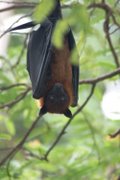
Meanwhile Chachoengsao Province, just to the north of Bangkok, is home to another type of creature, which some may find just as squeamish as snakes. These are the giant fruit bats or what some people call flying fox. They do indeed look like foxes with wings and are the size of chickens, the adults weighing at least more than a kilogram. The Thais call bats khang khao, roughly translated as the ones with the extremely smelly (in a fishy sort of way) chin. It is supposed to be an exotic cuisine in some kitchens. But I was told that when preparing a dish of bat curry or whatever, care must be taken never to break the saliva glands, otherwise the meat is useless because it is too smelly to eat. Thus the name khang khao. Some people have said their flesh tastes better than chicken and I fear I have to just take their word for it. But then again those who like to eat the meat of exotic animals always say that, be they dogs or frogs. Every meat on earth seemed to taste better than chicken meat, yet every body seemed to be eating chicken with such relish. All I can say is go eat a komodo dragon, then come back and tell me the meat tastes better than chicken meat.

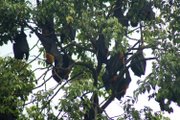
There seemed to be nothing remarkable about these particular group of fruit bats if not for the fact that they seemed to be extraordinarily smart. They have chosen to make their homes on trees at the Wat Pho Bang Rak, thereby ensuring that there is almost zero chance of any of them ever finding itself as the main dish at some exotic dinner. They leave the temple compound before night fall to feed at the nearby forests which make up the Khao Yai National Park and return just before dawn to sleep hanging upside down. There must be thousands of them perched on the branches from batman and batgirl to bat mama, bat papa and bat kids. Being blind as a bat during the day, the bats allow you to get up close and photograph them. It couldn’t just have been survival instinct that told them a temple is a safe haven. It must be extra sensory perception. To kill any of these creatures, while they are in the temple compounds would have been a cardinal sin.

Another creature had also found temples to be safe havens. These equally clever species of catfish are found in rivers situated near temples. Unlike the bats, the fish are, however, more commonly seen. As they make their home in the temple area, again no one is allowed to catch these fish. They have become rather pampered, though, relying on kind tourists for their daily food of bread and fish pellets. Most have grown to a few kilos and would have fetched quite a price at the market. But unlike some of their distant cousins in Malaysia, they never venture beyond the temple areas. Somebody once pointed out to me that in Malaysia they are called ikan jelawat. In Thailand, they are more popularly known as the smart catfish.

Thursday, June 07, 2007

Live by the sword, die by the sword

“A cobra can strike twice the distance its head is raised while a king cobra three times,” the Director of the Wildlife Department pointed out to me.

What this means basically is that if the cobra raised its head two feet above the ground it can lunge a distance of four feet, while for a king cobra the distance would be six feet. But not to worry, after a cobra or king cobra had struck once and missed, they need some time to regain their energy before delivering the second strike. Their heads would be raised, hooded and all menacing, but basically harmless for 10 seconds at least. If you are Carl Lewis, you would be a hundred metres away by the time the snake is ready to deliver the second strike. If you could not quite match Mr Lewis in speed or need a calculator to work out the snake’s deadly range then the next best thing to do is add an extra five metres to whatever answer you derive from your calculations. A 10 metre head start does not guarantee you would automatically outrun the king cobra should it decide to seriously give chase. But at least nobody can accuse you of being an idiot for standing too close to the reptile. And please bear in mind also that an adult king cobra can raise itself to about five feet and look you straight in the eye. Not a comforting thought, eh?

This conversation I was having with the Director of Wildlife Department was during a snake show at a village call Ban Khok Sa-nga in Khon Kaen Province, Northeast Thailand. I was acting as chaperone to a group of snake handlers from the Perlis Snake Farm who had been invited to perform at the said village, located 49km out of Khon Kaen town. Villagers in Ban Khok Sa-nga seemed to have very little fear of king cobras, which are kept as pets in most households.

Meanwhile up on stage a Thai snake handler was having a “boxing match” with a king cobra, slapping the snake’s cheek and darting out of the way every time it struck accompanied by a roar from the crowd. He was the village champion, a man just in his early 20s. Frustrated and certainly irritated, the snake at last gave up, unhooded its head and glided away looking for a dark corner to hide. That is what most snakes like doing, slither into a dark damp corner. Not very different from a few reptiles posing as mammals that I have encountered.

That particular snake secure at last in a box, out came a bigger one. A different snake handler this time pitted his agility against the new opponent. Again man proved to be too fast for the snake although he did not exactly stay the required distance my friend from the Wildlife Department had told me was the safe distance. But then they are all professionals and I on the other hand have this irrational fear of snakes, especially the venomous ones. Came from encountering cobras too many times as a child growing up on the outskirts of Kota Bharu in the 1960s. One day while home alone I also saw a pair of cobras slither under the house. We live in a house on stilts in those days. A cobra also killed one of my mother’s cat. It was soon put to rest, the snake that is, by a group of neighbours armed with bamboo stakes. In a terribly Hollywod or Bollywood manner, the cat actually waited for my mother to come home from work before taking its final breath.

According to those in the know, you can only kill a cobra with bamboo stakes though I reckon a baseball bat or golf club would also do the job if one is at hand. Only thing is that with a bamboo stake you can stand 10 feet away and have a go at it, while with a golf club or baseball bat you would have to get up very close and personal to do the job. Shy a creature as it may be a cobra cornered is definitely going to be in no mood to let you have a go at it without puuting up some sort of defence. And if you do not have the agility of a mongoose then you may end up ith a few love bites on your ankles. I was told that for some reason or other to keep snakes out of your compound sprinkle sulphur around your house. But personally I have found that kafir lime seemed to work better because sulphur tends to get washed away very quickly when it rains.

It was also pointed out to me that it is wrong to say that snakes or cobras in particular are poisonous. It is not, which explains why some people find their meat a delicacy. Others say drinking cobra’s blood is also supposed to cleanse your own blood. This accounted for the number of shops willing to slaughter cobras just so that you can clean your bad blood. Silly me, since all this while I thought drinking eight pints of plain water is good enough to get your kidneys to do the job of cleansing your blood. It seemed that some people had discovered a easier although somewhat less humane way to do the job. Personally I find going to the fridge for water a lot less distressing than going to the forests and trying to bag a cobra.

All snakes, however, are venomous, especially the ones whose heads are more or less triangular in shape. A baby king cobra, just hatched, already come equipped with enough venom to kill an animal a few times its size. A drop of venom from a king cobra or cobra is enough to kill 40 human adults or a horse. That should give you a good idea of how potent and dangerous their bite could be. Regardless of whether it is a fully grown adult or just a cute little baby. Certainly a case of the bite being more lethal than the bark. Strangely enough, the Thai name for a cobra is ngu hao (translated as barking snake). I did not find out whether cobras do indeed bark. I did not hear any barking from 10 feet away and have no desire to get any closer or give it a tight slap just to see if it emulate a dog. As a word of caution, no matter how much you desire to do so (especially the women out there) kindly refrain from giving a baby king cobra a cuddle even if your maternal instincts were deeply aroused.

Now we come to the who wants to be a millionaire questions:

After being bitten by a cobra or king cobra, how much time would you have left? The answer is cobra – 40 minutes, king cobra – 20 minutes (more or less). Next question, is it safe to suck the venom out with your mouth? Just in case you have no suction pump at hand. In theory, yes, provided you do not have a cavity. If not, the venom is now entering your blood stream through two channels. Good luck. Third question, why are the venom glands (located just behind its eyes) not removed for cobras used in shows? Removing the glands would kill the snake because it needs the venom to kill its prey and digest the food. Fourth question, why is it called a king cobra? Because it eats other snakes (including common cobras).

And the most important question of all, why the headline above? Well, our local Khon Kaen hero, the village champion had his last show a few weeks after I saw him performing. He made two mistakes that fateful day. First was not getting out of the way fast enough. The snake’s fangs went through his jeans and puncture the skin in his knee. Second mistake was thinking that since he had been bitten before he would have more resistance to the venom, so he continued with the show instead of seeking immediate medical treatment. It proved to be a fatal miscalculation on his part.

Friday, May 18, 2007

Getting Laid Back in Laos

The first thing that strikes you when you first enter Laos is that the urinals seemed to be placed rather low, about knee height. A fact which one of my travelling companions rather amusingly observed must be attributed the fact that Laotian men have short legs or they have great aim. Or as he smilingly pointed out they must have assets most South East Asian men would kill for. The Laotians we encountered during our four day visit proved to be of normal South East Asian height, so we are left wondering about the accuracy of their aim and other endowments.

Having sufficiently relieved ourselves for the long journey ahead, we got into our Thai-registered van after having our passports stamped at the Friendship Bridge Immigration checkpoint, one of the main entry points by road into Laos from the Thai town of Nong Khai in north east Thailand. It took a bit of getting used to for as we got out of the immigration complex, the van veered to the right and we made our way to the capital city of Vientiane. Laos, being a former French colony, is right hand drive which did not seem like much of a problem for our Thai driver. Left hand drive, right hand drive, one hand drive with the other on the phone all made no difference to him. He is an expert behind the wheels.

Our first day was to be a very long journey which is going to take up much of the day, about 10 hours. It was to be a journey through rugged country and mountain roads to the old capital of Luang Phabang. We had checked out of our hotel and left the Thai border town of Nong Khai at 7.00am. Our Laotian guide spoke excellent English as opposed to very little French. He explained that knowledge of English now is more of an asset than French, which was once the foreign language of choice in this land-locked nation of 6.3 million people. Those days are long gone. Now it is more fashionable to speak English. The fact that I speak Laotian pretty well even though it was only the second time I set foot in the country did not stop him from conversing in English with me almost the entire time I was there. Of course if you already speak Thai then speaking Laos comes easy enough. About 85 per cent of the words are the same. The divide used to be greater but most Laotians seemed to prefer watching Thai soap operas which are easily received through satellite dish, than their own government controlled development and entertainment programmes. As a result, the Laotians or Lao as they much prefer to be called, and the Thais now speak an almost identical language. The writing, however, differ but comes with similar pronunciations. But if you can figure out the squiggles that make up the Thai alphabet, then reading Lao text comes easy enough.

The journey from Vientiane to Luang Phabang was long and scenic enough with its mountains, valleys and rice fields. And there were just so much Laotian words I was capable of deciphering in a day. If for nothing else it was just to prove to myself that I was still young enough to learn a fourth language. Before long the eyes got weary and it was time for a snooze, but no sooner had all of us got comfortable enough when the van pulled into Vang Vieng, a small town of about 25,000 people. It was lunch time and the restaurant fronted what used to be an airfield for American planes flying sorties into neighbouring Vietnam during the Vietnam War. Now it just looked like a big highway leading to no where.

The town was nothing to shout about but on our return journey from Luang Phabang three days later, we spent the night at a scenic resort called the Elephant Crossing. It is a four-storey resort run by a Laotian man and his Australian wife. We were to find out why this place had grown in popularity especially among Caucasian backpackers. It offers quite a number of water activities like kayaking, rafting and tubing. Costing less than RM15 or so, inclusive of a trip to the launching point 3km away, tubing is actually a favourite pastime of tourists who like to laze around on the slow flowing waters of the Nam Song River on inflated tractor tyres. We were told that in July and August the waters of the Nam Song are actually very swift flowing and tubing can be quite hazardous to health but it was safe enough when we were visiting. Another favourite activity of the tourists is to swing from a platform about five metres high holding on to a piece of elastic rope and trapeze a quarter of the way out to the river. Then at the height of the third swing or so let go of the rope and free fall into the water. Seemed like fun thing to do. Certainly quite fun to watch especially when it was somebody in a skimpy bikini at the end of the rope. Makes for good action photographs too if you can get the speed and aperture right.

The town also consists of many B&B accommodation from below RM40 and a walk in town at night offers a few choices of things to do. This would include shopping for souvenir items, dancing the night away at a disco, having a massage or visit the equivalent of the local mamak restaurant complete with roti canai and teh tarik. You can imagine the happiness on my Malaysian travel companions’ faces when told they would be treated to the Malaysian favourite meal. By some coincidence, enough Malaysians must have visited the restaurant that teh tarik was not an alien name to the proprietor, who hailed from India, but have travelled through Singapore and Malaysia. The restaurant even has a branch in Luang Phabang by the same name. Or was it the head office, we never quite ascertained. American sitcoms are also the in thing, especially with the backpacking community and the folks of Vang Vieng had taken this to new heights. Quite a number of eating places offer the comfort of lying on mattresses with a headrest arranged in a row for you to sit and watch re-runs of Friends. The shops must be sharing the same tapes since several shops would be showing Friends but different episodes at the same time. So you can choose the ones you have not watched and for the price of a coffee or tea sit watching for hours on end.

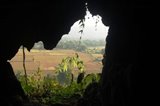
Another thing not to be missed in Vang Vieng is Tham Chang or Elephant Cave. With an entrance fee of about RM3, you get the privilege of crossing a hanging bridge before climbing a set of steps to a large cavern. From the main cave chamber, you will see one of the most scenic views of the Vang Vieng countryside. Most amazing of all was the fact that there were two rock openings, one shaped like the map of Borneo and the other, a shoe. It was a good thing that we stopped here only on our way back. Otherwise we may have decided to give Luang Phabang, some 300km away, a miss and while away our time in Vang Vieng instead. As it was those were about the only things we got to experience in the town, since we had less than a day there.

Luang Phabang, which used to be the capital of Laos, is now home to only about 25,000. Quite a sizeable number have migrated after the communist takeover in 1975. Now, after being declared a Unesco heritage site, it had turned into a town relying more on tourism than agriculture. Most of the old buildings have remained, some turned into guesthouses either to meet or in expectance of a tourist influx. Those who would not like to endure a van or car ride on Route 13 which connects Vientiane and Luang Phabang can either fly from the Lao capital or from Chiang Mai in north Thailand. But domestic air fares in Laos is quite pricy.

By the time we arrived and checked into our hotel it was way after sundown. A part of the town which had come alive, however, was the night market. A Lao pasar malam selling things from t-shirts and pants to Buddha images and other handicraft items. On both sides of the street are restaurants serving both local and Western food, which seemed to be quite a big thing, whether for dinner, lunch or breakfast. Breakfast at the hotel usually consists of two eggs, coffee and baguette. At least at dinner and lunch we got to sample Lao food, which is not altogether different from Thai food, only with fewer spices and other seasonings.

On our second morning in Laos we visited a village called Ban Lao Lao, just outside of Luang Phabang. The spelling may be the same but the meaning differs. The first Lao means whiskey and the second is of course the country. The village is reputed to produce the best Lao moonshine, containing some 50 per cent alcohol. By some coincidence the village is located on the banks of the Mekong River allowing those who need to cool off after a few shots of the extremely potent stuff to go for a dip. Incidentally the temperature in Luang Phrabang is quite cool in November, so lao Lao was a great way for the people to keep warm.

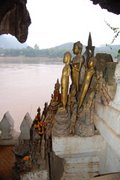
Here is also located a jetty for you to take a 20-minute boat ride upstream to Wat Tham Xieng Maen, where Buddha images of various types are kept. These images were from temples which have been torched during earlier wars between Laos and its neighbours or from temples which had fallen into disuse. A staircase leads up to another cave where more Buddha images are kept. Here you need a torchlight to find your way around and see the images.

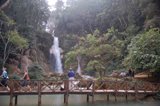
After lunch we headed for Wat Xieng Thong, which is Luang Phabang’s most magnificent temple. Built in 1560, its stupas house Buddha images from some 500 years ago. The walls of the chapel also has beautiful mosaic murals telling stories of the Buddha’s previous life before he attained enlightenment. Then we were off to Kuangsi Waterfall situated in a public park 32km out of town. This several tier waterfall is breathtaking in its beauty and there is even a pool for those who want to go for a swim at the lower level of the falls.

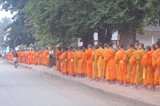
On our final morning in Luang Phabang we were up at 5am in order to go give alms to Buddhist monks. Some 80 over monks from the temples in town walk through the main streets which were lined with tourists and locals alike. Following the communist takeover of Laos in 1975 the practice of giving alms to monks were banned by the government, which felt that monks should go to work like everybody else. But the practice came back a year later after a huge outcry from the public, who felt that a religious practice ingrained in their lives for centuries should not simply be banned at the whims of the government whatever its political beliefs were. Now the practice of alms giving to monks in the early hours of the morning has become both a merit-making exercise and tourist attraction at the same time.

One final place we had to visit before leaving Luang Phabang was the Royal Palace Museum which was built more than 100 years ago. A blend of both Lao and French architecture, the palace was turned into a museum after the last Lao king, Savang Vattana and his family were banished to a remote area in northern Laos near the border with Vietnam in 1977. It was announced by the government that the king and his family were attending a re-education camp. But we were told that they were in fact banished to the cave prisons of Hua Phan close to the border with Vietnam. The king and his family passed away four years later from malnutrition and lack of medical attention.

The Royal Palace Museum is also where the Phabang Buddha image is kept. The Phabang or Phrabang is to the Laotians what the Emerald Buddha is to the Thais in terms of significance. In fact the Phabang image used to be in Thailand after King Rama I carted it back as the spoils of war in the 1700s. But what his great grandfather brought back to Bangkok, King Chulalongkorn or Rama V returned to Laos in the early 1900s. This was about the time when King Rama V also gave up Laos to the French and the northern states of Kelantan, Kedah, Perlis and Terengganu to the British.

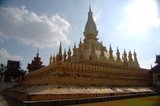
Retracing our journey we found ourselves on the final and fourth day in the Lao capital of Vientiene. With a population of over 200,000, it is the exact opposite of Luang Phabang. Here the streets are full of cars and motorcycles as opposed to bicycles. Here is also located the Pathat Luang, the most important national monument of Laos. This symbol of both the Buddhist religion and Lao sovereignty was built in the mid-1500s by King Setthathirat, whose statue sits majestically in front of the magnificent golden structure.

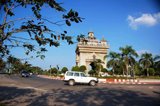
Another attraction not to be missed in town is the Patuxai or Victory Monument. Built in the 1960s, it was patterned after the Arc de Triomphe in Paris, which is exactly what Patuxai means in Laos. It is the most popular park in Vientiene with both the tourists and locals. Standing in front of the Patuxai with wide streets surrounding it, one could not help but whistle a French tune or other. It suddenly felt like a beautiful evening in Paris. Not too far away is the Vientiene Morning Market which contrary to its name stays open well into the late evening. It is a place to catch up on some souvenir buying for the friends back home before we were off to the Friendship Bridge Imigration checkpoint.

While waiting for our passports to be processed, we hopped into the many duty-free shops available. French wine were in abundance. I remembered the first time I was there several years ago. The girl in the duty-free shop had tried to pester me into buying some chocolates. We both had a good laugh when I told her the chocolates were made in Malaysia, where I came from. I just wanted Laotian t-shirts but she had none. She was selling Thai t-shirts instead and I could get a better selection at the Chatuchak Weekend Market in Bangkok.

All the official things over with we hopped into our van which switched back to the left side of the road for the journey into Thailand. One of the most amazing thing was that in the four days we were in Laos, not once did we see a policeman or soldier. But I supposed they must have been lurking inconspicuously somewhere waiting to pounce when you walk out of line. We just could not accept the fact that things can run smoothly even without the people in uniform around to make sure all rules and regulations were followed. After all the people in the Laotian uniforms in the mid-70s did create quite a bit of havoc with their purges and what not. But sure enough as if to make us feel more at home, right after crossing over to Nong Khai we ran smack into a police road block. Civilization at last, you might say.

Friday, April 20, 2007

Sri Vijaya revisited

Historians have hardly reached a consensus about it when in 1924 somebody discovered that there was indeed a kingdom called Sri Vijaya in this part of the world. The point of argument being where was in fact its capital. Whether it was Jambi, Palembang or even Chaiya? The first two locations are in south Sumatra while one is in South Thailand. Now it is generally accepted that the earlier two are almost certainly more correct. Two of the three capitals, at least.

Sri Vijaya at the height of its glory stretched from parts of Indochina down to what is now Indonesia and west to the shores of Africa and along the way encompassing present day Sri Lanka. If Palembang can lay claim to being the seat of power for a number of years, it cannot, however, claim to be the original capital. A stone inscription of Kedudukan Bukit (dated AD 683) proved that one Hyung Dapunta Jayanaga from Minanga captured Mukha Upang (Palembang). Minanga, located farther south on the east coast of Sumatra was referred to by I-tsing, a Chinese scholar as Shih-Li-Fo-Shih.

I-tsing stopped by there for four months to do his matriculation in Sanskrit under the tutelage of Buddhist monks before proceeding to Moloyu and on to Nalanda (India) for further studies. On his return after graduation, he again stayed in Shih-Li-Fo-Shih. He was to return there several times. Shih-Li-Fo-Shih at that time had very close relations with China. To confuse things further, Minanga subsequently disappeared completely from the face of southern Sumatra (sounds like it was the first case of tsunami to me). This first phase of Sri Vijaya lasted less than 100 years.

In came Sri Vijaya number two started by the Sailendras of Central Jawa, the first king being Balaputra Dewa. His capital city, however, was Swarnabhumi or golden land, referred to in Chinese chronicles as San-Fo-Tsi. This dynasty was to last from 860 to 1156. It was later defeated by Jawa and the old capital was relegated in status to old port. It was referred to by another Chinese scholar, Ma Huan as Chiu Chiang (old port). He put on record that Chiu Chiang or San-Fo-Tsi was also called Po-Lin-Fong. During this second period, San-Fo-Tsi also constructed a pagoda in Ligor (present day Nakhon Sri Thammarat in South Thailand).

Sri Vijaya III or San-Fo-Tsi II came into being from 1156 to 1373 under its first king Pangeran Suryanarana with its capital in Jambi north of Po-Lin-Fong. There were 15 states under the kingdom. Again according to Chinese chronicles (what would we do without them) among the states apart from Po-Lin-Fong were Pong Fong (Pahang), Tong Ya Nong (Terengganu), Ling Ya Si Kia (Langkasuka), Si-Lan (Ceylon) and Kui-Lan-Tan (Kelantan). Following that Sri Vijaya broke up into three kingdoms – Palembang, Minangkabau and Melayu.

At least while it lasted Sri Vijaya was huge by any standards, a commonwealth of sorts, rivalled by only China at that time and Alexander the Great’s territories at one time. Co-incidentally some of the Indonesian kings had claimed to be from Alexander’s lineage. His Indonesian name of course was Iskandar Zulkarnain. Others would claim to be descendents of Vishnu like Balaputra Dewa, who founded Sri Vijaya II.

It is little wonder that Chaiya (now most well-known for its salted eggs) in the province of Suratthani in South Thailand had also been put forward belatedly as one of the possibilities as its capital. But if it was, then one could certainly assume that its commerce would be a little more diverse than salted eggs.

Still there is no denying that Sri Vijaya have had quite a bit of influence in the region with statues and ruins from that period found littered all over Thailand and Indochina. The Thais have a name for that old kingdom – Sri Vichai (pronounced Sivichai). This would probably explain why traditional women dressing in Suratthani and Nakhon Sri Thammarat, for example, do not differ very much from those of the Indonesians. In addition, the name Vichai or Vichaya in Thai is actually Vijay on the Indian sub-continent and of course Vijaya in Indonesia. And Chaiya of course is Sri Vijaya with the Sri and Vi omitted over time and probably the best claim that it was indeed one of Sri Vijaya’s former capital city.

But Palembang, even if it could not claim to be the only capital of old Sri Vijaya, at least can now claim to be Indonesia’s fifth largest city. The name Palembang came about because of the fact that the place was water-logged and full of swamps. It still is a bit water-logged but now full of houses of different shapes, sizes and makes.

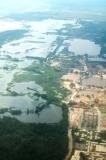
Seen from the air as the plane descended to touch down at Sultan Badaruddin II International Airport during my visit there, it seemed to me that the city of Palembang looked like a whole lot of water surrounded by patches of land. It certainly gave the impression that if the captain got his calculations terribly wrong and we were to miss the airport, we would eventually found use for a life jacket and whistle to attract attention.

The airport was impressive enough, not in the way KLIA or Suwanabhumi International Airport in Thailand are, of course. Getting out of the airport to the hotel in the city I was more impressed by the bottleneck jam. And that was just the queue to pay the parking fees. After that, it seemed like a breeze as every driver seemed to have their own idea about what constituted good driving and speed limits, so before long we were already at our hotel. I was to be more impressed by the fact that mini-buses seem to breeze around the city with the conductor’s door open and the conductors (no more than 15 or 16 year-olds) hanging three quarters of the way out soliciting passengers. How they manage to keep themselves from falling off or the doors from slamming into other vehicles or pedestrians is certainly a source of wonder especially at the speed most were going.

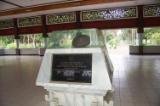
After the hotel, it was off for some nasi padang and a tour of the town’s hero’s mausoleum cum memorial. Sadly it did not seem well-kept and about the only name I could relate to was Parameswara’s brother, who was buried there. And in various corners of the park, courting couples court and cavort for there were a lot of grounds and hillocks to court and cavort in. One certainly wonders whether they were discussing the day’s homework or preparing for the next day’s biology test.

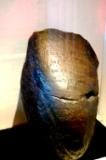
Then we were off again to see a stone inscription kept in a glass cage at the Sri Vijaya Historical Park. The stone bears the inscription in old Malay and was in fact the one referred to earlier as Kedudukan Bukit. Left unguarded a thief could have made off with it very easily, but he would have to be quite strong to achieve the feat. The old Malay language, according to a staff at the Palembang Museum we visited the next day, is now understood by only seven people in Indonesia. One in every 31.7 million Indonesians? Not bad.

The city of Palembang is divided by the Musi River, the somewhat impressive body of water seen from the air. One and the same river Parameswara, that naughty fellow who tried to usurp the Temasik throne by killing his host, set sail hurriedly (for the Majapahit troops were coming) for fame, fortune and adventure before settling in Melaka in the 1400s.

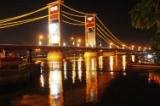
Across the Musi River is a bridge, known as Ampera. (I have just found out that this is actually short for Amanat Penderitaan Rakyat). There is a restaurant in Bandung with the same name. (See Bandung story in this blog). It as built in the 1960s, a gift from the Japanese government. Initially the centre part of the bridge could go up and down to allow ships to pass. It is no longer working. The mechanism had not been repaired presumably because they no longer want big ships to come in. We hired a speedboat to take us from the town to a small island a few kilometres upriver. Here is located a shrine dedicated to the memory of a Chinese prince, Tan Boon Ann, the love of his life Siti Fatimah, and her maid.

Local folklore has it that the Chinese prince after arriving in Sri Vijaya, had met and fallen in love with a Sri Vijayan princess. Her father the king, had demanded nine pots (tempayan) of gold as a marriage gift. The Chinese prince of course agreed. Nothing was too big for the hands of his love in marriage. Either that or gold could not have cost very much back in the good old days. After all going by the usual standards of a Chinese tempayan, one can assume that there were quite a few kilograms of gold in each of them.

However, the prince’s family decided that it would be safer to hide the gold among pickled vegetables in the container, just in case the ship were to encounter pirates at sea. All these, without first informing the prince about it. Goes to show the importance of being hands-on in whatever we do in life, especially such an important thing as preparation for a wedding.

When the ship arrived and the King demanded to see the gold, the who’s who of the Sri Vijayan high society trooped on board the ship. Imagine what thoughts must have gone through the prince’s mind when he discovered that the containers were just full of pickled vegetables, albeit, quite more than enough to serve with the porridge at his wedding ceremony. He was beside himself with anger and shame and furiously proceeded to throw the containers overboard. Goes to show again that if you are not hands-on, then make sure you double-check your facts before jumping to wild conclusions.

Strong as he might be. Angry as he might be, only so much can rage fuel outrageous strength. Those after all must have been pretty huge tempayans. After being fairly successful with the first eight containers, the prince didn’t quite muster enough strength with the last container. It missed the intended target and fell on board instead. The container broke into several pieces and out spilled its contents. Lo and behold for there nestled among the kiamchai were the gold for his dowry payment. Rage turned to despair for without the other eight containers he saw his marriage prospects sinking to the bottom of the river fast. He did what most sophisticated, unthinking men would do and jumped in after them.

An unsophisticated, thinking man would have just told the King, that was it, the marriage was off, and proceeded to set up a goldsmith shop with the last pot of gold and marry the chieftain’s daughter instead. But that would just not do and would have been a step down somewhat and His Highness Tan Boon Ann wasn’t prepared for that. So, into the Musi River it was. Well the Musi River is quite huge and deep that even now such a feat should not be attempted without a wet suit and full oxygen tank at least. But the prince did what he felt he had to do to redeem his family name even without the necessary martial arts training in extended underwater survival.

The love of his life, Siti Fatimah, who up until that point was only playing a peripheral role in the love story, decided to immortalise herself in local folklore by dramatically jumping in after him. But being Miss Sri Vijaya after all, she couldn’t go anywhere without her faithful maid. So together they jumped in after the prince before first declaring that should a piece of land rose from the waters that would be their tomb. True enough the piece of land emerged from the waters in the middle of Musi River, which the locals call Pulau Kemarao or Draught Island. Locals say that it never rain on this island. Ever. On the island are three mounds of earth, believed by the locals to be the tomb of Their Highnesses Tan Boon Ann and Siti Fatimah, and her loyal maid. There is a festival held annually to commemorate the occasion, attended not just by those of Chinese ancestry but by all and sundry in Palembang. A friend pointed out to me that there was even a song recorded by a Chinese singer some years ago immortalising this love story.

As I boarded the plane home, I could not help feeling a little disappointed at not finding more remnants of one of the most illustrious period in Indonesian history. If not for a tragic love story of a Chinese prince and a Sri Vijayan princess, I would have come home totally disappointed. Sucker as I might be for a great love story, it certainly wasn’t the way I had wanted to remember Sri Vijaya.

Wednesday, March 28, 2007

Only Muthu knows a Manikam

They say all that glitters is not gold. Sometimes it’s just a reflection of the sun on the water or the dazzling reflection of a temple’s roof in the afternoon sun. And before you let those things blind your eyes and cloud your judgement about gold and jewellery, it’s best to go find out a bit more about them. Most especially if you are a muthu who could not tell a manikam from a meenachi.

Some may adhere to the saying, mother knows best. I will not argue with that although I must say that mother only knows best about certain things. While some mothers can be down right experts in the field of jewellery purchasing, I must also add that there have been numerous occasions when mothers have made their way to my office to lodge complaints that they have been cheated by unscrupulous jewellers in Thailand.

Since I am no expert on jewellery either, having bought only one ring in all of nearly 50 years, it is certainly not my intention to teach shoppers how to buy such items. Of course, I am not counting the rings bought from sellers of trinkets on the roadside.

And having over the last 10 years had to help solve problems of people who felt they were getting a bad bargain after having bought such items, especially from jewellery shops in Bangkok, I certainly feel I should say something about it.

The advice summarised below are taken from the Jewel Fest Club’s written guide on how to buy gems in Thailand. The Jewel Fest Club was set up several years ago following numerous complaints from the public, especially foreign tourists to Thailand, that they have been cheated when buying jewellery. Members of the Jewel Fest Club are those who felt that not all jewellers should be branded as cheats and that members of the club are honest in their dealings. Or at least if customers should later find their purchases to be unsatisfactory, they can easily return them and get a refund. How much refund would of course depend on the length between the period the complaints were lodged and the purchases were made.

However, the best advice that I can give you is not to rely on other people’s advice solely, all the more so if you are not an expert on gemstones and jewellery. Always be on the side of caution. It could save a whole lot heartache later on, not just for you but for the person who has to entertain to your complaints.

As I said this is by no means a complete guide to gem buying, but it is hoped that it would give you a better understanding of jewellery before you go splash your year-end bonus or three-month’s pay cheque.

To start with, be aware of the weight and percentage of gold in jewellery, meaning the heavier and more percentage, the more expensive. In other words, take into account the weight, size, amount and quality of gems. Here the principle of the 4Cs should be applied. The 4Cs should not be confused with the term used in Singapore, which is CONDO, CASH, CREDIT CARD and CAR as a sign of a man’s eligibility as a husband. Anyway, buyers of jewellery should consider the weight of each gemstone because a single, large gemstone is more expensive than several small ones.

As mentioned earlier there are four criteria to judge gems known as the 4Cs. Firstly COLOUR. For diamond, the clearer and whiter, the more expensive. But for other gemstones, it is more difficult to evaluate. There are many kinds of gemstones and there has never been a single standard to judge them, unlike diamond.

Sapphire, for example, is a kind of blue gemstone. The most valuable kind of sapphire possesses a blue velvet colour while sapphires with much lighter or darker shades are relatively cheaper.

Ruby is normally red but the standard colour is vermilion. Paler or darker shades are slightly cheaper.

Emerald is a green velvet stone and the cheapest kind is the one that is light green, approaching yellow. And although they look almost the same green to the untrained eye, emerald should not be confused with jade. Put a piece of jade to your cheek and if it is cold, then it’s jade. Or so I was told. Another criteria is that jade are usually set in rounded forms while emerald can be cut into different shapes such small as squares.

To buy gemstones with their colours as the main criterion, customers should look for those with medium shades, not too light and not too dark. They can also seek an expert’s advice before making a decision. (The experts should not include university students you meet on the road or finely-dressed gentlemen in temples, or worse still, people masquerading as temple caretakers, for example).

Second of the C is CLARITY, which actually concerns the level of contamination inside a gemstone. The less contamination and fewer defects a gem has, the more expensive it is. Sounds easy enough, right?

Thirdly is the CUT, which basically is the shape and balance of the gem facets. A quality cut creates a glittering reflection inside a gem.

Fourth, of course, is the CARAT WEIGHT. Quality gems are priced by their carat weights while inferior ones are priced by unit tagged with a fixed price. One carat weighs 200 milligrams.

Then we come to the craftsmanship and designs. These should be self-explanatory. As they say, beauty is in the eye of the beholder. Some may prefer say an uncluttered small piece of ring like a wedding band while others may like to have something which resembles a deadly weapon.

Last but not least is buyer’s satisfaction. As jewellery is an art, there is no standard of pricing. Buying depends on the taste and satisfaction of individual buyers. Which is why as a word of caution, buyers should try and go to a standard jewellery shop and after making a purchase to request for receipts that clearly describe the details of the products, the dates of purchase, and the names of sellers, as well as for a warranty in order to prevent problems later on.

For more information, you can also visit the following websites:- http://www.jewelfest.com/ or http://www.thaigemjewelry.com/.

Friday, March 02, 2007

Coming to terms with your own greed

Imagine this. You’re walking with your husband or wife on a street in Bangkok. You’re taking a holiday after saving up for a few months. Tightening the belt every now and then just so that you can live it up a bit during your vacation. It is also a chance to spend a bit of quality time together and rekindle some romance. Nobody is getting on anybody’s nerve. He decides to overlook your buying all the things you do not need. She decides to overlook the fact that you are ogling the salesgirl. Nobody is coming home late from work. And nobody has to get dinner on the table after a full day’s work in the office. All is well in your neat little world and things can’t get any better.

But it can, according to a youth dressed in university attire (black pants and white shirt). Just around the corner is a temple housing a special Buddha image. The temple is open to the public only once a year, and only for a week. As your luck would have it this happens to be that particular week. Lighting incense sticks and prostrating before the image would bring you an eternity of good luck, says the youth, who was kind enough to direct you towards the temple.

As you enter the temple, there is a finely-dressed gentleman in office attire who had just finished his three prostrations before the said Buddha image. He smiled at you like the president of some exclusive club welcoming a new member. He is even prepared to advice you on what to do and how to pay your respects to the image of the noble one. You are grateful for the opportunity to usher in your good luck and do as you are told.

Then the gentleman discreetly tells you that during this period the government is having a jewellery promotion. In conjunction with the King’s birthday all the jewellery shops in Thailand are giving a 50 per cent discount on all items. But today is the last day of the promotion. A man sitting in a corner, who looks like the temple caretaker, suddenly chips in with his two bahts worth by confirming the gentleman’s statement. Well, if two people say it, then it must be the truth, you think. The man looks at his watch and tells you to hurry if you want to get something. There is a jewellery shop not too far from the temple. Again you cannot believe how lucky you have suddenly become. Prostrating before the Buddha image is already working wonders. Thanking him profusely you make your way out of the temple and there is a tuk-tuk and a driver on hand. The kind gentleman reappeared at your side to convince you that the tuk-tuk will get you to the jewellery shop in double time. To further prove his kindness he even gives the instruction in Thai to the driver to take you to the nearest jewellery shop. You marvel at the kindness of this gentleman who asks nothing in return. Seeing the joy on your face after coming into such good luck is payment enough for him. What an amazing chap and what an amzing stroke of luck on your part.

The two of you got into the tuk-tuk and in your heart you curse the Bangkok traffic jams for your delay in getting you to your destination. But not to worry, for a few traffic lights later the tuk-tuk stops in front of this impressive looking establishment. As if that is not enough, from the shop emerges another finely-clad gentleman, beaming from ear to ear. He can hardly wait for you to pay the tuk-tuk fare before ushering you into the shop. A lady steps up with a tray bearing drinks to quench your thirst.

The two of you feel like royalty as the salesman takes you from the diamond showcase to the ruby showcase. Then it’s off to the emerald showcase before finally stopping at the sapphire showcase. It is true, the salesman tells you. The jewellery shop is having a 50 per cent discount. Any item you buy today you can sell in your country for twice the amount. You make a few mental calculations and decide that selective purchases of a few items are not only worthwhile but may even pay for the whole vacation. Since the shop is treating you like royalty, it is beneath your dignity not to act like one. So you whip out not one but two gold cards from your wallet and hand them over to the kind salesman who promptly hand them over to the cashier. All payments duly made you gather your diamond necklace, ruby earrings, sapphire ring, emerald brooch and the receipt before heading out the door. You still cannot believe your stroke of good luck. Your ever efficient tuk-tuk driver is still lingering in front of the shop. So you hop in and tells him the name of your hotel. He is so kind his fare is also reasonable enough.

Upon returning home you decide to take the jewellery for an appraisal. The shop assistant tells you they are only worth about one-third of what you pay for them. That cannot be true. The stupid shop is making a mistake. So you go to another shop for a second opinion. The verdict is still the same. Suddenly there is a sinking feeling in the pit of your stomach. You pick up your phone and call the credit card company, trying desperately to stop payment. The lady who answers the phone tells you that that simply cannot be done. Payment has been made. Take up your case with the shop.

Suddenly a light bulb flash in your head. The light bulb that not once glimmered when you meet the university student, the finely dressed gentleman, the supposed temple caretaker, the tuk-tuk driver and the shop assistant. You decide to pay a visit to your local Tourism Authority of Thailand office. After all they are the ones who are going on and on about Thailand being the Land of Smiles, full of friendly people, where the food is great and the shopping stupendous. To be fair their promotions have never selectively state that only those with IQs above 220 are welcome in Thailand.

The receptionist you told your problem to points you towards the library, excused herself to go in search of the Public Relations person who is supposed to take care of such problems. He appears a few minutes later and introduces himself. Another Thai, you thought. By that time you no longer feel very warm towards all Thais and all things Thai. You swear you will never visit Thailand again, ever. You begin narrating your story but before you even get to the part about the men at the temple, he picks up the story and begins telling it at least up to the point where you arrive at the jewellery shop. You begin to get the feeling that this is not the first time he is hearing the story. You also cannot help feeling that he is less than sympathetic to your plight. He asks you to lodge a written complaint, which would then be forwarded to the head office and on to the appropriate people for further action.

You want to know if you can get back your money. Well about 85 per cent of it, he says, pointing to the fine print on the receipt that says all goods returned in good order within one month of purchase entitles you to only that amount of refund. You wonder how you missed that. He is non-committal when you ask how soon you can expect your money back. In fact you may even feel that he is not very helpful. So you ask why the government has not gone after these jewellery shops and close them down. The truth is for every shop closed down a few more will spring up with a different name and a different owner. How do you distinguish between the good ones and the bad ones? A group of people may have conspired to con you but until you put your signature on the credit card slip no transaction has taken place. They say you can lead a donkey to river but you can’t force the ass to drink. Horse, donkey or ass? Let us not debate too much about their biological differences, eh?

And if you are a muthu who doesn’t quite know which side of the manikam to look at, then before you whip out your gold cards next time, picture this. It is June in Malaysia. It is the Yang DiPertuan Agong’s Birthday. Do you ever remember the jewellery shops in KL or PJ or Penang having 50 discounts on their items to mark the occasion? If you are very sure that you cannot, then why in the world do you think jewellers in Thailand would act in such an unselfish fashion? What is using the name of the King in such a disrespectful manner if even the Buddha is desecrated by these people in such a fashion?

As an after thought, Prince Siddharta who went in search of the truth and finally found enlightenment and Buddhahood over 2500 years ago never ask that you prostrate yourself before his statue to reap good luck. His advice was to use your brain and power of intellect and learn to think for yourself. That is the way to change your luck. And of course, learning to let go. Letting go of greed and stupidity would surely be very high on that list. Prostrating yourself three times in front of any Buddha image is all fine and well. It is a mark of respect to a great man, to his teachings and to the sangha or body of monks who are keeping his teachings alive. Don't do it just to reap good luck as though that is your divine right. The Buddha passed away a long time ago. He no longer exists. He is powerless to change your luck. But his teachings can help pull you out of that mire of stupidity which is very often mistook for affluence.

Wednesday, February 07, 2007

Next time I’ll look out for the owl

While the idea of going off in a blaze of glory may be appealing, heroic even, the reality is that when the time almost comes, it isn’t all that much fun as you see in the movies. I read somewhere that dying is like falling off a cliff in slow motion. Certainly quite romantically put. Still I was glad that although I almost fell off a cliff and it was almost in slow motion, the final thud did not arrive.

But first things first. Just across from the state of Perlis on the Thai side of the border is located Satun. A province of caves, islands and hills. Lots of them. At the said time I was with a group of journalists and travel agents visiting a cave situated some way up a hill called Tham Phu Pha Phet.

We arrived at about 11am at the base of the hill and were supposed to climb some 350 metres or so to where the cave was located. A piece of cake. After all, I usually walk farther than that playing a round of golf. This shouldn’t pose too much of a problem for one such as I. What I forgot was that golf is played on a relatively flat surface area with the occasional gentle slopes thrown in for good measure. However, this was going to be a walk that was more of a non-stop climb. It would have been little problem had I been 30 years younger. But for someone in his late 40s with just the extra few kilograms around the waist and a few other places, it can be quite an effort. A case of the spirit being willing while the flesh being most reluctant to go the same direction. Any climber would tell you that at least you should have put your body through some form of exercise to increase your fitness level before making such expeditions. Playing golf once every two months coupled with smoking two packets of cigarette a day was just not it.

There is a theory propounded by a smoker, naturally, that those who smoke are better able to climb than those who don’t. This is because smokers are used to not getting enough oxygen, and as you get higher the air gets thinner meaning there is less oxygen going around. I was about to debunk the theory in a big way. A height of 300 metres up is not going to change the level of oxygen very much. Lungs coated with 20 years of nicotine, however, was going to affect such efforts a great deal.

An acquaintance who just had a quadruple by-pass later told me that you need to set a rhythm in order to climb effortlessly. Kind of a breathe, climb, climb, breathe, climb, climb. He had a lot of practice climbing one flight of stairs that way after his heart operation. Without the benefit of this wisdom, I was sort of doing something like stop breathing, climb, climb, climb, breathe, climb, climb, stop breathing, climb, climb again. To my credit, even with the erratic rhythm I was able to make it up about 50 metres or so before things began to go wrong. And when they go wrong, they tend to go wrong very fast. The knees kind of got soft and the oxygen intake could not quite keep up with the sudden change in heartbeat and abnormal lung functions.

With the benefit of hindsight, I would have to agree that it was a most foolhardy thing for an out of shape 47-year-old to do. Both in attempting to climb and later in my choice of resting place. Any amateur climber would have told you that you should pick a safe place for a rest. Well I thought leaning on a rocky wall was safe enough. Taking a stance with my feet firmly on the ground about a foot away from the base of the rocky wall, I leaned back and closed my eyes. That was my second biggest mistake of the day. I promptly passed out. And honest to goodness, I was actually hearing this beautiful piece of music before I came to. And no, it wasn’t coming from a harp. Before you read too much into it, it was probably just the part of my brain in charge of music, finding itself with some idle time and deciding to churn out those beautiful tunes. I must say it wasn’t altogether unpleasant, so I was certainly irritated when I heard somebody calling my name and trying to take me away from that pleasant drifting sensation. I forced myself to open my eyes. It was one of the travel agents who was walking some way behind. Good thing it wasn’t an owl calling my name. (There’s an old Eskimo belief that when you hear an owl calling your name, then you know your time is up).

Good thing the travel agent arrived when he did too. I was told that only the whites of my eyes were visible and my mouth was foaming. I was bent over 90 degrees in the direction of the cliff. Good thing too that I was doing it in slow motion. Either I was not getting enough oxygen, the sugar level had dropped sharply or I was having withdrawal symptoms from lack of nicotine.

Anyway it wasn’t really a sharp drop off the cliff had I really fallen forward. There were several big trees and rocks to break the fall, but I certainly don’t think it would have been a very comfortable place to end up or down as the case would have been. I just ask for a drink of water and told him to go on without me. That was as far as I wanted to go that day. After a few minutes rest and a cigarette, I made my way downhill. Incidentally the word sampoerna (in Indonesian), sempurna (in Malay) and somboon (in Thai) actually come from the same Sanskrit root, meaning perfection. Now that’s food for thought.

It would certainly be a while before I decide to climb another hill again. In fact later in the day when the rest of the group went white water rafting, I didn’t feel quite up to it and decided to give this new task a miss. The upside was that there was this very pleasant lady who taught me how to peel a mangoesteen with grace and perfection. I know how to do it the crude way of course. Since then I had been able to impress quite a few people with the newly acquired skill. And the lady certainly didn’t seem as life-threatening as the cliff and the rapids. So I was more than happy to be her student.

But climbing a hill again or just strolling on the golf course, if I ever hear that tune again you can be sure I’ll looking out for the owl. This time if it is calling my name, I would hate to miss it.

Friday, January 26, 2007

From Bangsar to Pattaya

One night I was having coffee with a few friends at a 24-hour fast food outlet in Bangsar when an argument broke out at the table behind us. While it was not an intense argument, the subject of the conversation between a Chinese girl and her Caucasian companion was enough to get our attention and had us straining our ears to pick up some choice titbits. They were actually trying to determine when was the most appropriate time for a boy and girl to go to bed together. The boy obviously thought it would be a perfect enough ending to the first date while the girl save for repeated “NOs” did not put a time frame on when she was going to prove her love to him. A good guess would be that if he was patient enough, it would have to come after the “Ama, yum cha” and just before the “Honey, can you take out the garbage” .

I am in no way trying to discourage any Caucasian reading this from having a go at it on the first date while in KL or any other parts of Malaysia for that matter. By all means, go ahead. You have taken our rubber and tin. What’s a few more pounds of flesh? It was a good thing you didn’t know about our oil then, isn’t it? Otherwise, we may still be part of the good old British Empire singing God Save the Queen instead of Negara Ku.

At the risk of being branded a male chauvinist and much as I didn’t want to take any side, I would have to say in the above incident the man had every right to think the she was fair game. You have no business being out with a man at three in the morning if you are not about to put out. Maybe she was just trying to determine how sensitive a man he was. Yeah, right! At least now she knows. What made her think men, whether they are blond or otherwise, differ all that much from continent to continent and country to country especially at that hour of the morning? Tie a yellow sari round any old oak tree and whether we are white or black or brown, chances are we would chase it depending on the state of our hormones that day. It is in our nature, you may say. You have to forgive us just like you forgive dogs that chase cars. Hopefully the man have met with some success since then and if not had moved on to bigger conquests. If he had not, then he just isn’t looking hard enough or maybe just looking in the wrong watering holes. There are many damsels waiting for him to come over on a white horse (or some modern carriage equivalent) to rescue them from a less than satisfactory life. And for those in similar situations and need help urgently go get a hold of a book call Sarong Party Girls that give you quite an insight into the nature of the sarong, the party and the girls, albeit in Singapore. Just kind of imagine the Singapore in the book is Bangsar or Pattaya. The Thai seaside resort on the east coast of Thailand is one place where the worst of the east seems to find its equal from the west.

After landing in Bangkok not too long ago, I had to pay baht 2,000 for the airport limousine to take me to the seaside resort to the east of the Thai capital. I was supposed to meet up with a group and supervise the shooting of a documentary there. Checked into a hotel that was situated right in the heart of mini-skirt land. That certainly ensured that I was going to get free music way into the wee hours for the two nights in a row.

After meeting up with the group on the first night and shooting a dinner scene followed by a stroll down the walking street where all kinds of goods were sold, I made my way back to the hotel on foot. Much as I would have liked to hang around longer in order to pick up some new dance moves, my stomach was giving me first day blues and I had to rush back to my room in double time. Having found relief at last I could then head for my window and look out over the street below. The night was still young and angels who had lost their Charlies were trying to hawk a dream or a fantasy to the next lonely man who had travelled here in search of some form of adventure. And if you are white, you may be in for an extraordinary time. You are after all the ticket to a better life and future for the purveyor of the dreams themselves.

For the ultimate, and sometimes elusive, dream is to hook some Caucasian visiting the seaside resort and get out of the rat race. The shorter their miniskirts the better is their passport to a new life. In the process, you must forgive them if they have become more Caucasian than the white men they are chasing. The only thing Thai that remains is their love for somtam or papaya salad.

But the trouble with such romantic dreams is that you have to wake up sometime. Although they can always hope, most bargirl’s story do not have a fairy tale ending. Reality tends to hit you like a ferocious kick to the stomach. Most often, that uneasy feeling in the belly the morning after is the result of a fertilised egg. They can try to dream the newborn would someday go on to find fame and success as actors or singers if they look good enough. However, more often than not they just remain as illegitimate testimony to a dream unfulfilled. Some may go on to inherit their mothers’ profession, thereby ensuring the vicious cycle continues. The odd one may even get to live out their mother’s dream. A prince charming to take them away from their pitiful existence. What does it matter if he is three times your mother’s age? What if it is just an old white man trying to rekindle some of his lost youth?

It is a story played out in most of the major tourist spots of South East Asia – Pattaya, Phuket, Koh Samui, Bali, Penang or even Bangsar. The actors playing the part may change, but the stories seldom differ.

Monday, November 27, 2006

Monkey Business in Lopburi

Picking up where we left off the last time about tigers, the strangest thing I have ever seen by far happened to be in Lopburi province, located about 150 north of Bangkok. If you are ever in Lopburi town try visiting the army zoo.

Go to the tiger cage and you may be surprised to see two grown tigers sharing the same enclosure with two dogs. The two local dogs seemed to be easy meat for the tigers should daily rations be reduced. But this has never happened because of an incident several years ago. A tigress at the zoo had given birth to two cubs but had refused to feed them. The superintendent of the zoo had no choice but to take the cubs home. His dog had given birth at about the same time. So the cubs were fed dog’s milk. In time, the dog adopted the tigers as her own. All the more so when the tigress continued rejecting her babies. The cubs grew up accepting the dog as their mother and the other dogs as their siblings. Now all share the same cage in the zoo. And when the tigers get a little playful, a sharp bark from the dog and they would run timidly for cover. It may have been a case of her bark being fiercer than her bite, but even tigers know that you do not cross your mother even if you outweigh her by 200kgs.

Some may argue that more impressive are the tigers who walk with the monks at a temple in Kanchanaburi. However, I have only seen this on TV and have not had a chance to pay a visit there yet.

While some people may miss seeing the tigers living with the dogs, if you are in Lopburi town, there is very little chance that you would miss another animal that had brought fame to Lopburi. They are the monkeys, which are seen walking around town by the hundreds. Every year a special feast is held for them. Unlike the tigers and the dogs which people find rather cute, the monkeys can be very mischievous and sometimes even downright intimidating, especially the big males. And the way they look at women sometimes make you wonder what exactly is going through their minds. Probably did not differ much from what was going through my mind then. They say the wise think alike and fools seldom differ after all.

There was once a case where a car had knocked down one of their brethren and a group of monkeys had actually taken matters into their own hands and attacked the car with stones and sticks. The driver was smart enough to lock his car and not come out to face their wrath and instead drove off before much damage was done to his vehicle.

Visitors to the area are warn before hand not to do anything that would harm the monkeys, which can be found in large numbers at the Phra Prang Sam Yot (Three Pagoda) ruins and the San Phra Kan Temple about 200 metres away. There is usually a group of children hanging around as vigilantes armed with their catapults ready to offer their assistance when help is needed. I actually witnessed a Caucasian man took out his camera and was about to insert a new roll of film when a monkey managed to snatch it away and made off with it to the top of the ruins. The children came with their catapults but before the monkey threw the film down, it actually managed to pull out the whole roll of film and expose it. Shortly after the incident, I was standing innocently snapping photographs when I felt my pants being tugged. Before you know it there was a monkey sitting on my head, peering down at my face. It would have been comical even to me had it not been for the fact that it was trying to take away my sunglasses. Without trying to appear as though I was picking a fight with him, I managed to hang on to the sunglasses with one hand and my camera with the other. After failing to get my Ray Ban the monkey decided to vent its frustrations on my moustache. I can assure you that having your moustache plucked by a frustrated monkey was not the most pleasant of sensations. Luckily before more of my facial hairs were removed the vigilantes appeared with their catapults and off went the monkey in double time. That seemed to be about the only language they understand. Boys plus catapults equal bad news for monkeys.

The locals have gotten quite used to these monkeys and had learned to live side by side with them. However, precautions are always taken like fixing grill on your windows and doors and fixing your TV antennas in inverted dishes to prevent the monkeys from getting to them. Still local folklore had it that the monkeys would sometimes do things which are so very human. One of them being travelling the modern way. The trains from Bangkok to Chiang Mai, of which there are seven daily, pass right through the heart of monkey town. A few monkeys had been known to hitch a ride on top of the trains to visit distant cousins in Chiang Mai and returning to Lopburi a few days later, presumably with a few tales to tell the folks back home. Why walk to Chiang Mai when there is a perfectly reliable train service available? Makes perfect sense.

Man and monkey did not always exist so harmoniously side by side in Lopburi town. There was a time when the monkeys were quite a handful and making quite a nuisance of themselves at the local wet market. One day a vegetable seller decided she had had enough of their nonsense and decided to get her own back at them. She presented them with a special gift, her Trojan horse, so to speak. This comes in the form of prawn paste or belacan. For those not quite familiar with the Malay proverb, macam kera kena belacan, let me say that for some reason or other prawn paste brings on an allergic reaction of volcanic proportions in primates. The itching epidemic of such magnitude afflicting the monkey population of Lopburi town had never been seen again since. Following that the council of elders governing the monkey world must have sat down and passed an edict that all monkeys may only roam freely within certain demarcated areas that include the ruins, temples and train station. Take a train to Chiang Mai if you must, but venture not into the wet market. The humans there take no prisoners. The food is not up to scratch anyway.