Anybody growing up in the 1960s would probably remember a song called Ole-ole Bandung (Souvenirs from Bandung). The lyrics had something to do with a short blouse being cut into a sarong or something like that. The reason for this song or rather the lyrics, I was to find out, is that the traditional costume for Sundanese women (who you find in large numbers in Bandung) is a sarong worn just half way down the calf with a kebaya (also known in Kelantan as baju Bandung) on top.
I was in for another surprise where the Sundanese were concerned. It happened when we walked into a restaurant for lunch on the way to Tangkuban Parahu, a mountain range housing six dormant volcanoes, about 20kms out of Bandung town. The girl who greeted us put up her hands in a wai position. Being Thai and being terribly polite especially with sweet-looking young things, I instinctively put up my own hands and replied “Sawatdi khrap” before realising that I was not in Thailand. (Wai is the Thai greeting and involved putting the palms together at about chin level).
It turned out that the Sundanese greeting happened to be a version of the wai, although they do not call it a wai. In fact they do not call it anything except a Sundanese greeting. And who better to demonstrate this than a Sundanese girl in traditional costume. She did it with such beauty and grace. How I wish we were 30 years younger.
Our age did not stop the driver from taking the trouble to extol the virtues of women from the various areas of Java, though. Sunda, Cirebon, Jakarta, Semarang, Surabaya, Yogyakarta and so on. My friend, whose ancestry can be traced to both the royalty of Cirebon and the pirates of Sulawesi was all ears. Our driver, being Javanese himself, was naturally trying to convince us that the best candidates for wives were Javanese. Moreover, he said, getting married in Indonesia would only cost us in the range of two million rupiah or so. Now, that is food for thought, especially for two poor, old bachelors.
Anyway let us just leave the wives part out of it for the moment. Too many damsels and all of them managed to have a distress story of some sort to tell. We seemed spoiled for choice and somehow it looked much easier to remain bachelors, especially at meal times.
Meals in Bandung usually consist of a fish dish. Of course there is also sapi (bull) meat. Not lembu, mind you. The sapi meat is usually served as miniature satays. A word of advice. If you are wearing dentures stay as far away from it as possible. The sapi must have had their fair share of skirmishes with quite a few local matadors judging from the tougness of their meat.
But hardly had we set foot on Indonesian soil and my friend was already talking about pacel lele. It is actually deep fried catfish eaten with vegetables and sambal. In the interest of gastronomic science, he was trying to determine if there was any difference in tastes between the pacel lele served at Indonesian restaurants in Kuala Lumpur and those found in Bandung. Much like he once went to Hat Yai, Bangkok and Chiang Mai to see if the tomyams there and those in Kuala Lumpur taste the same.
On our second night in Bandung, after hopping into a taxi, we politely requested him to take us in double time to the nearest restaurant selling pacel lele. The taxi driver must have misunderstood our Sundanese dialect because he deposited us near Jalan Sudirman where we found lots of shops and stalls selling bakmee but not pacel lele. We hopped into another taxi and asked the driver to take us to the nearest Muslim restaurant, instead.
This time there was no room for mistake and the waitress in tudung kind of convinced us we were in the right type of restaurant at last. Called Ampera, it is located in Jalan Kebun Kawung, somewhere between the Bandung Governor’s Residence and the Railway Station.
The deep fried chicken drumstick served here more than compensated for the missing catfish. Having found Sundanese food rather bland over the previous two days, my friend and I tucked into the sambal with gusto. Only this time it was not so bland. Being Thai I pride myself in my ability to stomach hot food. But this was something else altogether. It was like a few mini explosions had just gone on inside my mouth. I must say the numbing sensation moved us to tears and we were sweating in places that had no right to sweat at that hour of the night. But it was nothing that two tall glasses of freshly-squeezed orange juice (locally known as jeruk) could not take care of. Naturally there was no sirap Bandung. Sirap Bandung is a fallacy propagated by the back street vendors in Malaysia. Just like there is no nasi goreng Pattaya in the Thai seaside resort. Now I actually begin to wonder whether what my late grandmother called baju Bandung actually originated in Bandung at all.
But Bandung, being close to 800 metres above sea level has a rather cool temperature. It seemed to rain most of the four days we were there. I suppose if the temperature dropped lower than normal, the people of Bandung can always visit Ampera. The sambal would certainly warm them up somewhat. We did manage to find our pacel lele the very next day. Wonder of all wonders it was at a restaurant located 20 metres from our hotel.
Of course, pacel lele was not the only thing my friend was fond of. The other is fighting with taxi drivers. He seemed to have taken the fight from the streets of KL to back streets of Bandung over their reluctance to use the meter after midnight. Still they were a whole lot friendlier than their counterparts in KL. None argued or protested when we paid them half of what they asked. They were smiling broadly because probably they were still making a hefty profit.
I was just smiling because the taxi drivers did not take us to some dark alley and relieve us of all our worldly and unworldly possessions. After all, picking a fight with taxi drivers at three in the morning, whether in KL, Bangkok or Bandung is not very clever. But try telling that to my friend, the gaped crusader, who felt that justice must prevail and “broken meters” should be repaired.
We did encounter some very pleasant taxi drivers as well in Bandung. And my friend was not averse to giving a big tip to the honest drivers. If only they knew how much more they could have made from the tips if they had just used the meters in the first place.
The first thing I did after arriving back in Kuala Lumpur was to go check the next available cheap flight (translated as RM0.00) to Bandung. We were not quite finished with the pacel lele, the sambal in Ampera and the Bandung taxi drivers just yet. And, I had to come back to KL to find out that a replica of the Java Man is actually exhibited in the Bandung Museum. Now that us something I would like to have a look at. Of course, there is still the two million rupiah question to be answered. Tsk, tsk the things we do in the name of journalism.
Showing posts with label Bandung. Show all posts
Showing posts with label Bandung. Show all posts
Thursday, September 21, 2006


From the Mouth of a Volcano
I cannot help feeling smug. It is not always that I can say I am a millionaire. There I was, crossing the 50 metres or so of tarmac from the plane to the Immigration check point at Hussein Sasteranegara International Airport in Bandung with a few million rupiah on me. Malaysia had just beaten Indonesia for the gold medal in badminton at the Manila SEA Games.
While walking around smugly is one thing, gloating is quite another. It would be a fatal error, I think, to gloat at Indonesians, especially about Malaysia beating them at badminton. I could very easily end up at the bottom of Kawah Ratu, a dormant but the biggest of six volcanic craters on the outskirts of Bandung. I really have no desire to test how hot the temperature can get at the bottom of a volcano, even a dormant one.
For Indonesia, losing to Malaysia in badminton must rank somewhere between the tsunami and running out of clove cigarettes. But then neither do Malaysia like losing to Indonesia in badminton even back when we were losing to every other nation of some badminton repute in the world.
A few days later Malaysia beat Indonesia for the soccer bronze medal. However, by then I was past my gloating stage. Just as well to let it pass since our host and guide was kind enough to show us several variations of lap dancing. All to the accompaniment of music from Michael Learns to Rock, fast tempo and in dangdut version, naturally.
While still humming the non-dangdut version of 25 Minutes Too Late, we took the winding road up to the mountain in a Kijang (which is actually the Indonesian national vehicle minus the AP controversy naturally). The locals just call it puncak (summit), the mountain that is, not the locally-assembled four-wheel drive. The temperature dropped quite fast and we had the air-conditioning switched off and wound down the windows to have a better look at the swiftly changing vegetation and pollute our lungs a bit more.
Then the inside of the four-wheel drive began to take on a slightly unpleasant odour as if all of us were having indigestion and were playing childhood pranks on one another all at the same time. Nothing of that sort was happening, of course. The sulphuric smell was coming from the six volcanoes in the area.
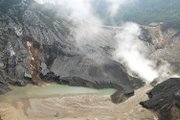
Dormant they may be, but they were definitely emitting strong fumes and smoke that you can smell from quite a distance away. The fact that it had been years since the volcanoes were last active was scant consolation when we stood staring down at the smoky bowels of Kawah Ratu, the biggest of the six craters. We did not make it to the other five for lack of time. To the left of Kawah Ratu and making a wonderful background to the setting of an Indonesian myth was the Tangkuban Parahu mountain range.
As is always the case with any tourist attraction, there would be the usual souvenir peddlers whose vocabulary did not include comprehending the word NO. It was small consolation that some of them were kind enough to take us through the folklore associated with the area. You can tell they have been telling this story countless times to anyone patient enough to lend an ear. But nothing’s ever for free and the price for the story telling was being haggled no end by the story teller and his comrade in charms to buy their wares.
One cheeky fellow wanted to sell me a horn shaped volcanic stone with Quranic inscriptions. When I managed to convince him that I was not a Muslim, he was stumped for a few seconds and quickly put away the holy inscriptions. And that was that, I thought, when suddenly he turned around and there were strings of beads, necklaces and bracelets in his hands. His friends chipped in with some bamboo pens and postcards just for good measure. All were trying to outdo each other with their salesmanship. They were as amazing as the myth connected with the area.
It happened that once upon a time, many tectonic movements and tsunamis ago, in heaven lived a young god. One day he committed a sin with a beautiful goddess (must have been heaven’s version of playing doctor) and they were condemned and banished by the highest God of Sunda Pantheon to live on earth as animals. The goddess turned into a female wild boar, while the god turned into a black dog.The black dog was called Si Tumang. One day a Sunda King, who was hunting in the forest got lost and had the urge to urinate, so he did it in a dry coconut shell. The boar, which was thirsty, accidentally drank the King's urine that was mixed with his sperm. After several months, the boar got pregnant, but instead of giving birth to baby boar, she gave birth to a beautiful baby girl.
The boar then took her baby to the King's hunting log. The King and his men were surprised to find a beautiful baby in the forest. The King considered the baby as a gift from the gods and took her as his own daughter. The baby grew up to be a beautiful princess. The princess is loved by everyone in the kingdom, but she turned out to be a spoiled girl.
The princess was very skilful at cloth weaving. One day her weaving tool drop from the weaving pavilion. Too lazy to pick it up, she vowed that if there was a male that would pick up her weaving tool, she would make him her husband, but if a female were to pick it up, she would make her a sworn sister (this is Sunda after all, so no same sex marriage just yet).
However, it was Si Tumang who took her weaving tool and gave it back to her. Because of her vow, Princess Dayang Sumbi must marry Tumang, the black dog. Ashamed of his daughter’s mistake, the King banished Dayang Sumbi to the forest, living with Tumang, her dog husband (and these days we call that incest and bestiality). During the night, Si Tumang would turn into a handsome god and make love to Dayang Sumbi. Soon Dayang Sumbi gave birth to a baby boy named Sangkuriang. However, Sangkuriang did not know that his beloved and loyal pet, Si Tumang, was his own father. One day Dayang Sumbi had a craving to eat fried deer liver and asked her teenage son to go hunting. Sangkuriang took his dog, Si Tumang to hunt, but strangely, there was not a single animal in sight. Then Sangkuriang spotted a fat boar so he shot an arrow at it. The boar was the goddess incarnation, mother of Dayang Sumbi, Sangkuriang’s grandmother and Si Tumang’s amorous accomplice in Sunda heaven. Si Tumang knew this and he tried to stop Sangkuriang from killing the divine boar. Angered by his pet’s attitude, Sangkuriang accidentally shot an arrow at Tumang, and killed the dog. Confused and depressed, Sangkuriang then cut out Si Tumang’s liver and took it home. Dayang Sumbi cooked Tumang’s liver and ate it. Sangkuriang remained silent and did not want to eat the cooked liver. When Dayang Sumbi asked Sangkuriang where Tumang is, Sangkuriang told her the truth. The shocked Dayang Sumbi ran amok and hit Sangkuriang on the head with a ladle. Sangkuriang’s head was cut wide open and bled, and he suffered from amnesia.
Sangkuriang ran into the forest. Dayang Sumbi, who regretted her actions went looking for Sangkuriang but in vain. Dayang Sumbi then began a life as a hermit, eating only raw vegetables. Thanks to her diet and divine blood, she was able to remain young forever. Sangkuriang grew into a strong and handsome young man and was reunited with Dayang Sumbi and they later became lovers (a touch of Oedipus there, what?). Finally, Dayang Sumbi recognised the scar on Sangkuriang's head while combing her lover's hair and realised that her lover was actually her own son, so she knew she could not marry him.
However, she did not wish to disappoint him by cancelling the wedding. But she would only do so on condition that he provided her with a lake and a boat with which they could sail away on the dawn of their wedding day. Sangkuriang accepted this condition and built a lake by damming the Citarum River. With dawn just moments away and the boat almost complete, Dayang Sumbi realised that Sangkuriang would fulfil the conditions she had set. With a wave of her shawl, she lit up the eastern horizon with flashes of light. Deceived by the false dawn, the cock crowed and farmers rose for the new day.
With his work not yet complete, Sangkuriang realised that his endeavours were lost. In uncontrollable rage, he kicked the boat that he had built. The boat overturned and became the mountain range known as Tangkuban Parahu (in Sundanese tangkuban means upturned and parahu means boat). With the dam broken, the water drained from the lake, turning into a wide plain that now became the city of Bandung (from the word bendung, which means dam). DH Lawrence couldn’t have written a better story.
After our fair share of Oedipal folklore and persistent souvenir peddlers, we made our way to the hot spring or air panas at the base of the mountain. A welcome change from the rather low temperatures of the puncak.
While walking around smugly is one thing, gloating is quite another. It would be a fatal error, I think, to gloat at Indonesians, especially about Malaysia beating them at badminton. I could very easily end up at the bottom of Kawah Ratu, a dormant but the biggest of six volcanic craters on the outskirts of Bandung. I really have no desire to test how hot the temperature can get at the bottom of a volcano, even a dormant one.
For Indonesia, losing to Malaysia in badminton must rank somewhere between the tsunami and running out of clove cigarettes. But then neither do Malaysia like losing to Indonesia in badminton even back when we were losing to every other nation of some badminton repute in the world.
A few days later Malaysia beat Indonesia for the soccer bronze medal. However, by then I was past my gloating stage. Just as well to let it pass since our host and guide was kind enough to show us several variations of lap dancing. All to the accompaniment of music from Michael Learns to Rock, fast tempo and in dangdut version, naturally.
While still humming the non-dangdut version of 25 Minutes Too Late, we took the winding road up to the mountain in a Kijang (which is actually the Indonesian national vehicle minus the AP controversy naturally). The locals just call it puncak (summit), the mountain that is, not the locally-assembled four-wheel drive. The temperature dropped quite fast and we had the air-conditioning switched off and wound down the windows to have a better look at the swiftly changing vegetation and pollute our lungs a bit more.
Then the inside of the four-wheel drive began to take on a slightly unpleasant odour as if all of us were having indigestion and were playing childhood pranks on one another all at the same time. Nothing of that sort was happening, of course. The sulphuric smell was coming from the six volcanoes in the area.
Dormant they may be, but they were definitely emitting strong fumes and smoke that you can smell from quite a distance away. The fact that it had been years since the volcanoes were last active was scant consolation when we stood staring down at the smoky bowels of Kawah Ratu, the biggest of the six craters. We did not make it to the other five for lack of time. To the left of Kawah Ratu and making a wonderful background to the setting of an Indonesian myth was the Tangkuban Parahu mountain range.
As is always the case with any tourist attraction, there would be the usual souvenir peddlers whose vocabulary did not include comprehending the word NO. It was small consolation that some of them were kind enough to take us through the folklore associated with the area. You can tell they have been telling this story countless times to anyone patient enough to lend an ear. But nothing’s ever for free and the price for the story telling was being haggled no end by the story teller and his comrade in charms to buy their wares.
One cheeky fellow wanted to sell me a horn shaped volcanic stone with Quranic inscriptions. When I managed to convince him that I was not a Muslim, he was stumped for a few seconds and quickly put away the holy inscriptions. And that was that, I thought, when suddenly he turned around and there were strings of beads, necklaces and bracelets in his hands. His friends chipped in with some bamboo pens and postcards just for good measure. All were trying to outdo each other with their salesmanship. They were as amazing as the myth connected with the area.
It happened that once upon a time, many tectonic movements and tsunamis ago, in heaven lived a young god. One day he committed a sin with a beautiful goddess (must have been heaven’s version of playing doctor) and they were condemned and banished by the highest God of Sunda Pantheon to live on earth as animals. The goddess turned into a female wild boar, while the god turned into a black dog.The black dog was called Si Tumang. One day a Sunda King, who was hunting in the forest got lost and had the urge to urinate, so he did it in a dry coconut shell. The boar, which was thirsty, accidentally drank the King's urine that was mixed with his sperm. After several months, the boar got pregnant, but instead of giving birth to baby boar, she gave birth to a beautiful baby girl.
The boar then took her baby to the King's hunting log. The King and his men were surprised to find a beautiful baby in the forest. The King considered the baby as a gift from the gods and took her as his own daughter. The baby grew up to be a beautiful princess. The princess is loved by everyone in the kingdom, but she turned out to be a spoiled girl.
The princess was very skilful at cloth weaving. One day her weaving tool drop from the weaving pavilion. Too lazy to pick it up, she vowed that if there was a male that would pick up her weaving tool, she would make him her husband, but if a female were to pick it up, she would make her a sworn sister (this is Sunda after all, so no same sex marriage just yet).
However, it was Si Tumang who took her weaving tool and gave it back to her. Because of her vow, Princess Dayang Sumbi must marry Tumang, the black dog. Ashamed of his daughter’s mistake, the King banished Dayang Sumbi to the forest, living with Tumang, her dog husband (and these days we call that incest and bestiality). During the night, Si Tumang would turn into a handsome god and make love to Dayang Sumbi. Soon Dayang Sumbi gave birth to a baby boy named Sangkuriang. However, Sangkuriang did not know that his beloved and loyal pet, Si Tumang, was his own father. One day Dayang Sumbi had a craving to eat fried deer liver and asked her teenage son to go hunting. Sangkuriang took his dog, Si Tumang to hunt, but strangely, there was not a single animal in sight. Then Sangkuriang spotted a fat boar so he shot an arrow at it. The boar was the goddess incarnation, mother of Dayang Sumbi, Sangkuriang’s grandmother and Si Tumang’s amorous accomplice in Sunda heaven. Si Tumang knew this and he tried to stop Sangkuriang from killing the divine boar. Angered by his pet’s attitude, Sangkuriang accidentally shot an arrow at Tumang, and killed the dog. Confused and depressed, Sangkuriang then cut out Si Tumang’s liver and took it home. Dayang Sumbi cooked Tumang’s liver and ate it. Sangkuriang remained silent and did not want to eat the cooked liver. When Dayang Sumbi asked Sangkuriang where Tumang is, Sangkuriang told her the truth. The shocked Dayang Sumbi ran amok and hit Sangkuriang on the head with a ladle. Sangkuriang’s head was cut wide open and bled, and he suffered from amnesia.
Sangkuriang ran into the forest. Dayang Sumbi, who regretted her actions went looking for Sangkuriang but in vain. Dayang Sumbi then began a life as a hermit, eating only raw vegetables. Thanks to her diet and divine blood, she was able to remain young forever. Sangkuriang grew into a strong and handsome young man and was reunited with Dayang Sumbi and they later became lovers (a touch of Oedipus there, what?). Finally, Dayang Sumbi recognised the scar on Sangkuriang's head while combing her lover's hair and realised that her lover was actually her own son, so she knew she could not marry him.
However, she did not wish to disappoint him by cancelling the wedding. But she would only do so on condition that he provided her with a lake and a boat with which they could sail away on the dawn of their wedding day. Sangkuriang accepted this condition and built a lake by damming the Citarum River. With dawn just moments away and the boat almost complete, Dayang Sumbi realised that Sangkuriang would fulfil the conditions she had set. With a wave of her shawl, she lit up the eastern horizon with flashes of light. Deceived by the false dawn, the cock crowed and farmers rose for the new day.
With his work not yet complete, Sangkuriang realised that his endeavours were lost. In uncontrollable rage, he kicked the boat that he had built. The boat overturned and became the mountain range known as Tangkuban Parahu (in Sundanese tangkuban means upturned and parahu means boat). With the dam broken, the water drained from the lake, turning into a wide plain that now became the city of Bandung (from the word bendung, which means dam). DH Lawrence couldn’t have written a better story.
After our fair share of Oedipal folklore and persistent souvenir peddlers, we made our way to the hot spring or air panas at the base of the mountain. A welcome change from the rather low temperatures of the puncak.
Subscribe to:
Comments (Atom)